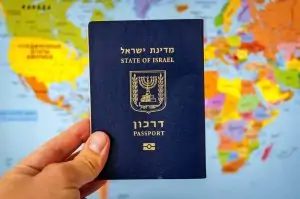
Permanent residency in Israel is the dream of many people living in the country on a residence visa. The gap between the dream and reality is very wide. Without in-depth knowledge of Israeli bureaucracy and the support of a professional who knows the field thoroughly, the road to permanent resident status is, at best, a very long process and, at worst, one that will not end successfully.
What Is Permanent Residency in Israel?
Permanent resident status in Israel means the ability to stay in the country and enjoy almost all the rights to which an Israeli citizen is entitled, from full social benefits, through full coverage by the health funds, to various rights with the National Insurance Institute.
One of the main differences between a permanent resident of Israel and an Israeli citizen is the right to vote in Knesset elections. It is no wonder that many foreign nationals who have been living in Israel for a long time hope to receive permanent resident status: no limit on the length of stay, no need to renew a residence visa every year, and, of course, economic and social security and a status equal to that of all Israeli residents.
However, the road to this status is full of difficulties, prolonged frustration, and considerable suspicion on the part of Ministry of the Interior officials, who view every applicant for permanent resident status as someone whose motives are suspect.
Obtaining Permanent Residency in Israel: In Practice
As is typical in Israel, processes of this kind are long, exhausting, and frustrating. First, it is necessary to understand who is entitled to receive, or at least to apply for, permanent resident status in Israel:
Spouses of Israeli citizens
Parents of soldiers
Elderly parents of an Israeli citizen or permanent resident
Foreign nationals seeking to live in Israel on humanitarian grounds
The Process of Becoming a Permanent Resident:
The process of obtaining permanent resident status for spouses of Israeli citizens and for spouses of permanent residents of Israel takes about five years. Although the process ought to be natural and smooth, since these are couples who want to build a life together, Israel puts many obstacles in their way throughout the application period. The main reason for this cumbersome process is apparently the suspicion Ministry of the Interior officials show toward every foreign national and the sincerity of his or her motives.
To verify the genuineness of the relationship, the couple must submit a series of documents that confirm and attest to the existence and genuineness of their relationship, including a birth certificate and a certificate of good conduct, a personal status certificate for the foreign partner, photos of the couple together over the years of their relationship, various evidence and affidavits, and more.
As if that were not enough, they must go through personal interviews, conducted separately, to confirm that they really live together, know each other, and have genuine intentions.
But the saga does not end there. Even if the Ministry of the Interior officials are convinced that the relationship is genuine, the foreign partner will receive an A/5 residence visa.
This is a temporary resident visa, and it is granted for one year only. Every year, for four years, the foreign partner must go to the Ministry of the Interior and renew it. Only after five years can permanent resident status in Israel be requested. If the couple is not married, the process is even longer and takes about seven years.
If not all the required documents are submitted, and there is no advance preparation by a lawyer who specializes in Ministry of the Interior law and is well acquainted with the process of applying for permanent residency in Israel, many couples who did not prepare properly may find their application refused, and the foreign national will have to leave the country without becoming a permanent resident. Advance preparation and professional guidance are therefore crucial.
As for parents of soldiers, these are foreign nationals whose children serve in the IDF. The family reunification procedure provides that such parents are entitled to permanent resident status. Here too, the process first requires the parents to obtain a B/2 visitor visa for 3 months. After that, they can receive a temporary residence visa (A/5), and only 4 years after receiving the temporary residence visa can they apply for permanent residency.
The process of obtaining permanent resident status for elderly parents who are not citizens or residents of Israel allows them to receive this status within about three to four years. First, the elderly parent must receive an A/5 temporary residence visa. Only after at least two years have passed since receiving this visa can the elderly parent apply for permanent residency.
Foreign nationals staying in Israel on humanitarian grounds can also apply for permanent residency in Israel. The process is long, cumbersome, and fraught with difficulties, since there are no clear procedures for this population. It can take ten years or more and requires the support of an experienced professional representative; otherwise the chances of success are slim.
The Obstacles
The main obstacle facing applicants for permanent resident status in Israel is bureaucracy. Add to that the suspicion of Ministry of the Interior officials regarding applicants’ motives and a lack of in-depth familiarity with the procedures for obtaining permanent resident status, where such procedures exist, and you have a process that few get through smoothly, or at least one fraught with difficulty and frustration.
The help of an immigration lawyer who knows Ministry of the Interior procedures is significant. If the spouse of an Israeli citizen does not fill out the required forms or fails to present one of the required pieces of evidence, the application will be rejected, and entry into and stay in Israel will be refused.
At best, the application period will be extended. If parents of soldiers or elderly parents fail to present proof of their relationship with their children, or to meet additional requirements, some of which may even sound illogical, or if they do not make sure the documents are authentic and signed by an authorized signatory, here too the difficulty will only grow.
Many applicants find themselves up against a fortified wall, not knowing how to get around these obstacles and unable to do so. These are sensitive matters that already stretch over a considerable period, and there is no reason whatsoever to prolong it further. It is a process that is almost impossible to carry out on your own without knowledge of the law.
The Solutions
Knowing the law, being familiar with its many nuances, and finding solutions even in situations that seem impossible are the domain of professional immigration lawyers who have been doing this work for a long time and are aware of all the difficulties and obstacles and, above all, of how to get around them. You will find an example of this in the following ruling:
Adm. Appeal 16-12-4789 Yael Eisenberg and Goya Nimer Galtan Win v. Population and Immigration Authority
This was an appeal filed by the Association for Civil Rights in Israel with the Tel Aviv District Court. The petitioners were Yael, an Israeli citizen, and Goya, a Sudanese national seeking asylum in Israel. Yael and Goya met, fell in love, became a couple, and moved in together. The two applied to regularize Goya’s status as a permanent resident under the common-law partners procedure.
Couples, whether married or not, in which one partner is an Israeli citizen and the other is not, undergo tests of the genuineness of the relationship to confirm that it is an authentic relationship and not one used for immigration purposes.
To this end, they enter a graduated procedure lasting several years to obtain status in Israel, during which the foreign partner’s details are checked and the genuineness of the relationship is examined over several years.
Yael and Goya successfully passed the tests of the genuineness of their relationship. The Population and Immigration Authority was convinced that the relationship was genuine. Nevertheless, the Immigration Authority did not allow the two to begin the graduated procedure to regularize Goya’s status in Israel, because he lacked documents. The Authority refused to include the appellants in the graduated procedure and agreed to extend the appellant’s residence permit only under Section 5A of the Entry into Israel Law.
The appellants filed an appeal against the Population Authority’s decision, arguing that because Goya is an asylum seeker, and given the situation in Sudan, it is impossible to locate documents, let alone submit authenticated documents from Sudan as required. The proceeding in question is an appeal against the judgment of October 16, 2010, in which the appellants complain that the only reason they cannot advance in the graduated procedure is the appellant’s inability to produce documents from the Sudanese authorities.
They asked the court to declare that the man could upgrade his status within the graduated procedure for partners and complete it by acquiring permanent status, and that progress in the procedure and its completion would not be conditioned on producing documents from the Sudanese authorities.
The Tel Aviv District Court accepted the appeal filed by the Association for Civil Rights in Israel.
According to the court, once the Authority was convinced that the relationship was genuine, it should have allowed Goya to enter the graduated procedure for regularizing the appellant’s status, without any condition regarding the documents it had demanded of him. In its judgment, the court noted the difficulties faced by asylum seekers in Israel, especially in this unusual case, where the applicant is in a relationship with an Israeli citizen, a relationship the Authority admitted it was convinced was genuine, and yet the Authority did not allow Yael and Goya to join the procedure for regularizing the status of partners.
The court held that immigration law should be treated as the new family law, encompassing questions concerning the right to family life, parenthood, and the best interests of the child. It further held that, given the importance of the right to family life, that right may be denied only in exceptional circumstances, and the procedures should be interpreted in a way that allows family life in Israel.
With the Right Help, You Can Achieve the Right Results
Despite the many difficulties Israel places before those seeking permanent residency, and despite the many changes and amendments in temporary provisions and new regulations that change almost daily, it is still not an impossible task.
Professional guidance from an immigration and status regularization lawyer in Israel is important and necessary, and above all, it makes it possible to find the many potential loopholes in the law. You just need to know the law thoroughly, and such knowledge may completely change the decisions of the immigration authority.