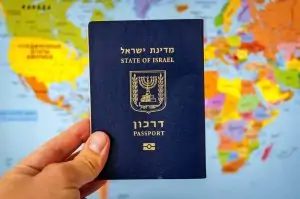
Israel has several types of visas, or entry permits, which differ according to the purpose of entry into the country.
Citizens of which countries need a visa for Israel and which do not, and what are the circumstances of entry that determine the type of visa?
The Laws of the State
A foreign national who wishes to enter Israel may do so only if he or she complies with the Entry into Israel Law. New immigrants, who are entitled to enter the country under the Law of Return, are exempt from this rule.
In addition, there are countries with which Israel has a bilateral agreement, such as Australia, the United States, and the countries of the European Union, whose citizens receive a visa on arrival in Israel.
It is important to understand the difference between entering Israel and residing in Israel. Entry concerns crossing the border, while residing in Israel concerns staying in the country.
The main difference between the two is that entering Israel requires a visa, while staying in Israel for more than three months requires a residence permit, even for citizens of countries exempt from an entry visa to Israel.
So Who Needs a Visa for Israel?
As noted, every person visiting Israel for tourism or a visit, for a period not exceeding three months, may enter Israel with a visa, that is, an entry permit. Citizens of some countries will receive the entry permit (tourist visa) on arrival in Israel, while citizens of other countries must arrange to obtain a visa in advance in their country of origin, by applying to the embassy or consulate in their country. If they do not do so, they will not be allowed to enter Israel.
The countries whose citizens need a visa in advance to enter Israel (tourist visa) are:
Afghanistan
Algeria
Uganda
Antigua and Barbuda
Armenia
Azerbaijan
Bahrain
Bangladesh
Bermuda
Bolivia
Burundi
Venezuela
China
Côte d’Ivoire
Eritrea
Ethiopia
Gambia
Ghana
Jordan
Kenya
Kazakhstan
Iran
Egypt
Indonesia
Morocco
Moldova
Mozambique
Nicaragua
Nepal
Senegal
Lebanon
Laos
Tunisia
Turkey
Sri Lanka
Nigeria
Pakistan
Sierra Leone
Solomon Islands
United Arab Emirates
Yemen
and others
The countries whose citizens do not need to apply for a tourist visa before arriving in Israel include the United States, Canada, Australia, England, Switzerland, Germany, Italy, France, New Zealand, Russia, Japan, Cyprus, Greece, Spain, Portugal, and others.
For the full list of countries exempt from a visitor visa to Israel and the countries whose citizens need a visa for Israel, click here
The visa in question is a B/2 visa, a visitor/tourist visa. As noted, it allows entry into Israel for tourists or for private visits.
This visa also applies to other visitors in specific circumstances, including:
- The spouse and children of a foreign expert working in Israel
- A business visitor coming for business meetings, including sessions, discussions, and the like
Citizens of countries that do not need to obtain a visa to enter Israel before arriving will receive the visa on entering Israel, at border control.
* There are, of course, exceptions to the above regarding visas in special periods, such as the period of the spread of the coronavirus and its consequences, when flights to Israel from specific countries, or in general, were suspended.
Every Rule Has an Exception
On the face of it, it seems that citizens of countries exempt from a visa for Israel can easily pass through Ben Gurion Airport and receive an entry permit without any problem or concern. In practice, reality shows that every rule has an exception.
The countries exempt from a visa for Israel, that is, countries whose citizens do not need a visa in advance to visit Israel, are countries with reciprocal visa exemption arrangements, because they voted at the UN in favor of the establishment of the State of Israel, or because they have commercial or diplomatic relations with Israel. Other countries are members of the European Union, which allows entry into Israel without a visa.
Still, the question arises whether all citizens of these countries can enter and visit Israel whenever they wish. The answer may be surprising, because in practice this is not always possible.
Ironically, a citizen of a country that requires an advance visa will go through the application process, pay the fee, and arrive in Israel knowing with confidence and certainty that he or she will enter the country.
It is precisely citizens of visa-exempt countries who can board a plane to Israel and find themselves going back the way they came, after border control officers did not allow them to enter the country.
Why Does This Happen?
First, it should be understood that border control officers have broad powers, and they can exercise discretion even in the case of citizens of visa-exempt countries seeking to enter the country.
Second, if these officers are concerned that the tourist is attempting unlawful immigration to Israel, or that there is a threat to the security of the State, they may refuse to allow him or her to enter Israel.
A security concern is a situation in which the question arises whether the person seeking to enter Israel intends to harm the State. Recently, the definition of “harm to the State” has even been expanded to include considerations of support for organizations that are hostile to Israel and call for a boycott of it, or any other hostile organization.
The concern of unlawful immigration and work in Israel is the second reason that may lead border control officers to refuse entry to citizens of visa-exempt countries. This means that the visitor declares an intention to visit Israel as a tourist, while in fact he or she plans to remain in the country beyond the period approved in the visa and to work there unlawfully, without a work visa.
How do border control officers know that this is indeed the tourist’s intention? There are several considerations that may raise their suspicion, for example:
Has the tourist been deported from Israel in the past?
Has the tourist tried to enter Israel in the past and been refused?
Is there a known place in Israel where he or she will stay during the visit?
Does he or she have sufficient resources to fund the visit?
Is his or her financial situation in the country of origin stable, and does he or she have a regular job?
Other considerations are the country of origin and the tourist’s age. A young person from Georgia, for example, which is considered a poor country, will arouse more suspicion than an older tourist from Canada.
So How Can a Tourist Make Sure of Entering Israel?
It is important to show the border control officers that the tourist’s life back home is orderly, for example by showing that he or she owns an apartment or rents one, has a regular job from which he or she has only taken a vacation, and even details of his or her financial situation. It is also important to show that the tourist has a place to stay, money to fund the stay in Israel, and so on.
If entry to Israel is nevertheless refused by border control, it is important to know that the decision can be appealed, but you must act quickly, because once the removal order has been issued, entry into Israel will automatically be barred for about ten years.
It is very important to contact, without delay, an Israeli visa lawyer who is well versed in the laws governing entry into the country and can prepare and file the appeal quickly.
An Illustrative Ruling: Appeal Against the Refusal of Entry of an American Citizen – LAA 7216/18
The petitioner, Lara Alqasem, was refused entry by the border authority on arriving in Israel, even though she was an American citizen entitled to receive a B/2 tourist visa. Moreover, she intended to continue her studies at the Hebrew University of Jerusalem after receiving a scholarship, and had even applied for and received an A/2 student visa.
Her entry into Israel was refused because of her past activity in the SJP organization. Her appeal to the Appeals Tribunal was rejected, and her administrative appeal to the Court for Administrative Affairs was also dismissed (Adm.
Appeal 11002-10-18). The court held that the respondent, the Ministry of the Interior, was entitled to cancel her residence visa and prevent her entry into Israel because of her activity to promote a boycott of the State of Israel. The next step was an application to the Supreme Court.
In this application, with legal representation by an immigration lawyer, it was argued that the applicant would not have come to study in Israel, of all countries, had she had malicious intentions, and that her participation in the movement calling for a boycott of Israel had been marginal, negligible, and done in her youth.
From the Supreme Court’s ruling on the refusal of entry “for reasons of public security, public safety, or public order”:
“The applicant argues that the authority that Section 2(d) of the Entry Law grants the Minister of the Interior is limited to preventing the entry of a person who is currently acting on behalf of an organization or body calling for a boycott of the State of Israel.
Therefore, there was no reason to prevent her entry, since she has not been a member of such organizations since April 2017 at the latest. The applicant emphasizes that the Ministry of the Interior did not present any evidence of her involvement in the activities of boycott organizations in later periods, and that its claims on this matter, which were raised for the first time at the appeal stage, were not accompanied by details or supporting documents.
The applicant adds that, in light of its infringement of fundamental rights, including freedom of political expression, Section 2(d) of the Entry Law must be interpreted narrowly, and certainly must not be extended beyond the criteria approved by the Minister of the Interior and the Minister of Strategic Affairs.
Since the SJP student organization is not one of the ‘prominent’ boycott organizations, and the applicant herself never engaged in ‘actual, consistent, and continuous activity to promote boycotts,’ she does not fall within those criteria, and the Ministry of the Interior’s decision in her case was made without authority.
On the level of reasonableness, the applicant reiterates that there is no basis for the concern that she will use her stay in Israel to promote a boycott of the State. Beyond her undertaking before the Appeals Tribunal not to act in this way, her determination to become part of Israeli academia is the antithesis of boycott activity and casts serious doubt on the concern that she will call for such a boycott in the future.
The applicant argues that she never concealed from the authorities any information she was asked about, and believes that, in view of her actual conduct, namely her wish to study in Israeli academia, the attempt to present the deletion of her social media accounts as evidence of support for a boycott of Israel is far from convincing.
The applicant also presents letters from professors and lecturers at the University of Florida attesting to her interest in Israel and to the meaningful and respectful dialogue she conducted with Israeli counterparts.
In these circumstances, she argues that decisive weight should have been given to her reliance on the visa lawfully issued to her two months before she landed in Israel, since the applicant currently has no apartment or job in the United States, and the train of the current academic year has already left the station.”
The Supreme Court accepted the arguments of the applicant and her lawyer, overturned the decisions of the Ministry of the Interior and of the lower courts, and allowed her to enter Israel.
The importance of acting quickly lies mainly in the concern that, if the applicant is returned to his or her country, entry into Israel will be barred for the next ten years. The speed of the legal response is therefore critical.